Table Of Content:
Basic Blackjack Terms
Let’s start with the essentials! Below are the must-know terms covering the basics of the game, like who’s playing, what the dealer does, and how the cards work.
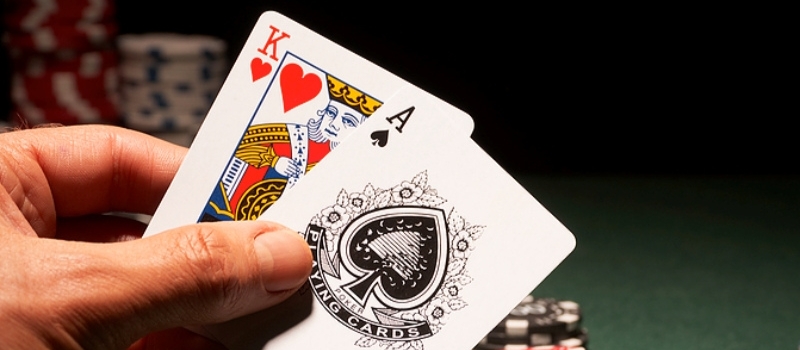
- Blackjack: The best possible hand in the game. It’s when your first two cards add up to 21, typically an Ace (worth 11 points) and a 10-point card (like a 10, Jack, Queen, or King).
- Hand: The set of cards you have during a round of blackjack. For example, if you’re dealt an 8 and a 6, that’s your hand, which totals 14.
- Action: The player’s turn to decide what to do with their hand (hit, stand, double down, or split).
- Dealer: The person or system representing the casino in the game. The dealer gives cards to players and plays against them according to the casino’s rules.
- Player: You or anyone playing blackjack against the dealer.
- Deck: The set of cards used in the game. Blackjack is often played with multiple decks of 52 cards to make counting cards harder.
- House: The casino. The house is who you’re playing against in blackjack and who sets the rules for the game.
- House edge: The casino’s edge over players. In blackjack, the house edge is relatively small (around 0.5% in optimal play), meaning the casino expects to win about 50 cents for every $100 bet.
- Payout: The winnings if your hand beats the dealer’s. A typical blackjack payout is 3:2, which means that you win $3 for every $2 you bet if you hit blackjack. Read this article to know more about blackjack 3 to 2 payout.
- Odds: The probability of a certain outcome happening, such as getting a blackjack or the dealer busting. Good players use the odds to decide their best move.
Once you have grasped the basics, move on to more detailed terms in the next sections!
Card Value & Type Terms
Blackjack is all about the cards, and every card has a role to play. These terms explain the values and types of cards you’ll see during the game.
- Ace: A card that can count as 1 point or 11 points, depending on what benefits your hand more. For example, if you have an Ace and a 7, your total is 18; if you draw a 10 after that, the Ace counts as 1 to avoid going over 21. In this guide, I’ve shared some blackjack Ace rules you need to know, check it out!
- Paint: Refers to the face cards in a deck (Kings, Queens, and Jacks). They’re called “paint” because of their detailed, colorful artwork. Each is worth 10 points in blackjack.
- Ten-value card: Any card worth 10 points, including the 10, Jack, Queen, or King.
- Bust card: A card that makes your hand go over 21, causing you to bust and lose the round. For example, if you have 16 and draw a 7, you bust with a total of 23.
- Burn card: The first card taken out of the deck before the hands are dealt. The dealer burns this card to prevent players from gaining an advantage by seeing it. It’s common in both physical and online games for fairness.
- Upcard: The dealer’s face-up card that all players can see.
- Hole card: The dealer’s face-down card that is revealed after players finish their turns. The hole card, combined with the upcard, determines the dealer’s total hand.
- Cut card: A brightly colored plastic card placed into the shoe by a player/dealer to “cut” the deck after shuffling. It indicates when the dealer will reshuffle during the game, ensuring fairness.
